
During 2024, we have had several Masters students working on projects related to the Chalk Sea Ecosystems grant. These posts will introduce you to a few of them and their research projects!
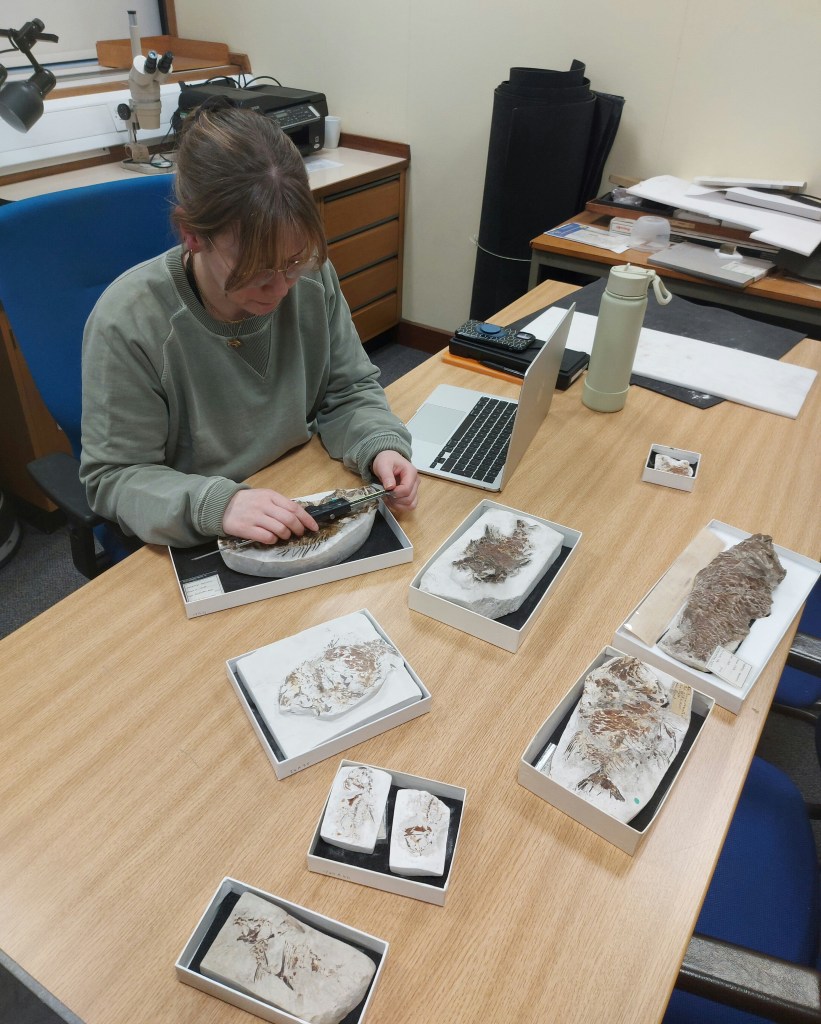
Chloe Griffiths measuring specimens of Hoplopteryx from NHM collections.
Who are you? What course are you on? Who is your supervisory team?
My name is Chloe Griffiths, I am on the MRes Biodiversity, Evolution and Conservation course at UCL. For my first research project of this course early in 2024, I was based at the Natural History Museum, supervised by Richard Twitchett, James Witts, and Emma Bernard.
Tell us about your project?
In my project, I focused on Hoplopteryx: An extinct genus of fish from the Trachichthyidae family, also known as ‘Slimeheads’. I used the extensive collections of well-preserved fossils of Hoplopteryx from the English Chalk, located in the Natural History Museum and across other UK institutions, to investigate body size changes in this genus during the Late Cretaceous. The body size measurements I obtained were compared with palaeotemperature estimates derived from oxygen isotope analysis of the bulk chalk matrix surrounding each specimen. This study furthered our understanding of the temperature-size relationship in Hoplopteryx and provided some insight into the Trachichthyidae response to warming seas.
What was the most exciting result?
It was fascinating to see tiny rings on fossilised fish scales called circuli and annuli which can be used to determine the biological age of a fish – even one that died millions of years ago!
What was one interesting fact about chalk from your project that you didn’t know before?
That past ocean temperatures can be estimated from the concentration of oxygen isotopes (δ18O) in chalk.
 ChaSE
ChaSE 