

Harriet Bohun databasing NHM Cenomanian-Turonian macrofossil samples.
Who are you? What course are you on? Who is your supervisory/advisory team?
My name is Harriet Bohun, and I became interested in the field of Evolutionary Biology during my undergraduate degree at the University of Bath. This year I have completed my Masters in Taxonomy, Biodiversity and Evolution based jointly at both Imperial College London and the Natural History Museum. I completed an independent research project with Professor Richard Twitchett and Dr James Witts as part of the ChaSE team. For the study I used a large collection of macrofossils made by Professor Andy Gale (University of Portsmouth) and colleagues, held at the Natural History Museum, London.
Tell us about your project?
My project investigated functional and ecological changes in marine ecosystems during the Cenomanian and Turonian stages of the Cretaceous Period. During the Cenomanian (100 – 93.9 million years ago), shallow continental shelves were flooded by high sea levels, creating the chalk sea, which is characterised by increased calcium carbonate content from fossil plankton. The end of the Cenomanian coincided with climate changes associated with ‘Ocean Anoxic Event 2’ (OAE-2) million years ago, which led to a second order mass extinction event.
I studied this event at Eastbourne in the Anglo-Paris Basin. This location has extensive chalk outcrops which have been the focus of previous research into the impacts of OAE-2 on taxonomic diversity and extinction. My work instead focused on changes in the ecology of the marine ecosystem during the Cenomanian and early Turonian. Ecological function is an important method of assessing the impact of taxonomic loss on the ecosystem health and therefore recovery from extinction events and climate perturbations. Large taxonomic loss when spread between different functional groups may be less damaging than a smaller taxonomic loss that wipes out one functional group that is highly important for ecosystems function.
I found that at Eastbourne, there was a significant dissimilarity in taxonomic composition of the communities between the Cenomanian and Turonian across OAE-2. Locally, Eastbourne experienced a 50% loss of ecological functional groups; free-living organisms on the seafloor were particularly affected. We intend to continue working on this project to increase the database of samples and carry out further geochemical analyses to investigate the causes of this decline.
What was the most exciting part? And/or: what is one interesting fact about chalk you’ve learned from your project that you didn’t know before?
The most exciting part was branching into and learning more about geology! My background was in biology, so learning how important geology is to bridge the gap between biology and palaeontology was very exciting. The most interesting thing I learned was how there are actually different types of chalk, how these are formed, and how that can indicate different things about past environments. This project has really ignited a love of the geological side of Natural Sciences and this is an area I would be interested in pursuing during a PhD.
I was also particularly grateful and excited by the opportunity to volunteer with the NHM at the Lyme Regis Fossil Festival, where we got to work with school groups, teaching them about palaeontology and climate change among other topics. It was great to speak with young aspiring scientists and encourage their passion! This is something I look forward to doing more of in the future.
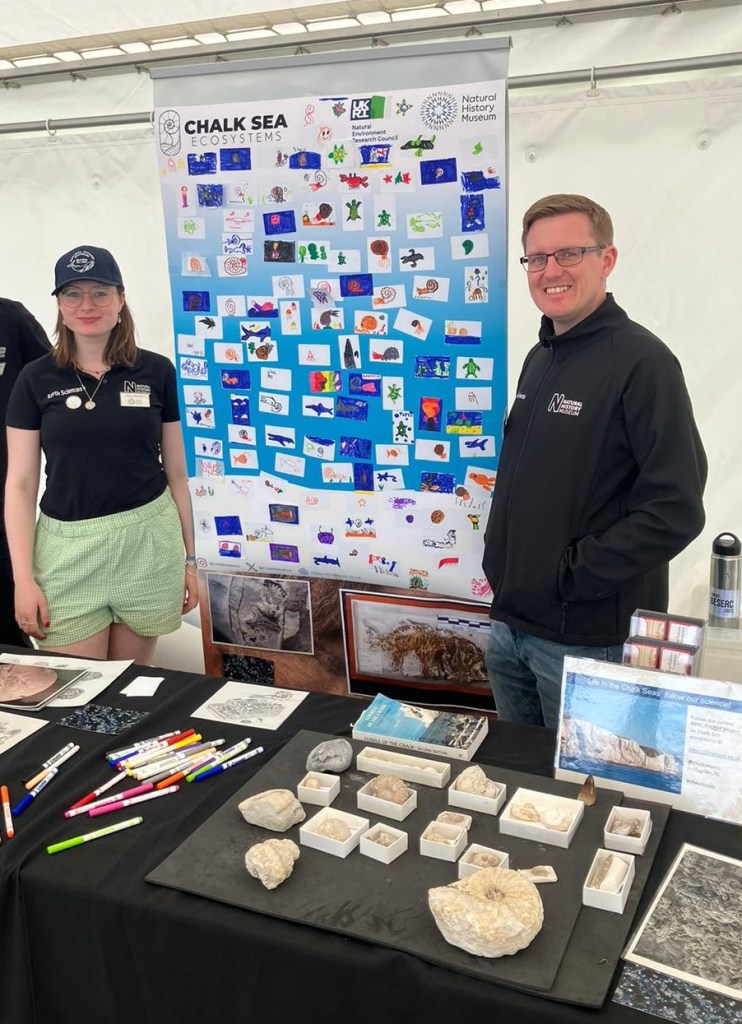
Harriet Bohun and Dr James Witts conducting public outreach on Chalk Sea Ecosystems at the Lyme Regis Fossil Festival, 2024.
 ChaSE
ChaSE 