
Who are you? What course are you on? Who is your supervisory team?
My name is Kaia Spence. I have just completed an MSci in Biological Sciences: Zoology (International Program) at University College London. The extended research project which I worked on throughout the duration of my fourth year mostly took place at the Natural History Museum and formed part of the ChaSE project. I was supervised by Richard Twitchett, James Witts, and Emma Bernard.
Tell us about your project?
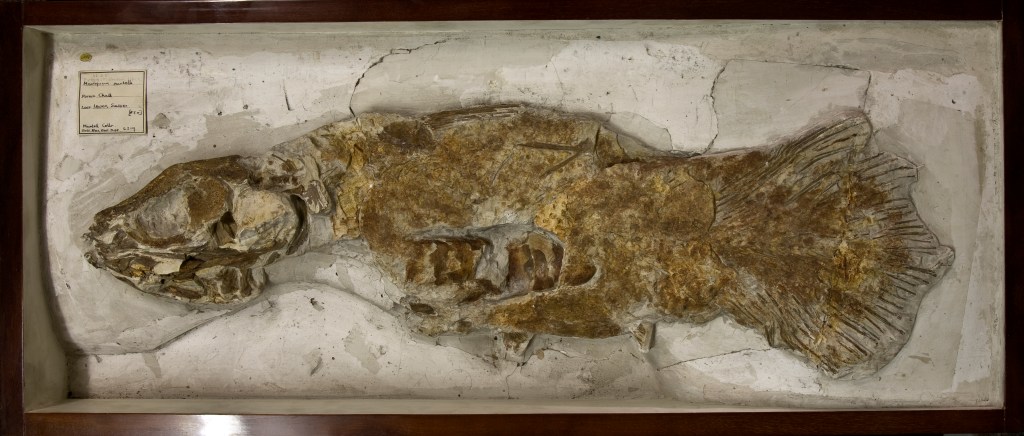
The size-temperature relationship predicts that adult body size of marine fish will decrease with increasing ocean temperature. I studied this relationship in the UK Chalk Sea fish genera Ctenothrissa, which may be ancestral to the spiny-finned fishes (Acanthomorpha), and Macropoma, which belong to the same family as living coelacanths (Latimeriidae). Measurements of each were recorded and used to estimate length of incomplete specimens. Lengths were compared to sea surface temperature (SST), which was estimated via oxygen isotope analysis of the bulk chalk matrix surrounding fish specimens (analysis done at the Bloomsbury Environmental Isotope Facility at UCL). This study showed a complex relationship between size and temperature in these genera. This is in contrast to recent ChaSE work on the chalk ‘slime-head’ Hoplopteryx, and suggests that the size:temperature relationship may not apply in the same way to all fish. This is important in considering how modern coelacanths may respond to climate change.
What was the most exciting result?
Macropoma were found to only be present in the UK Chalk Sea during the warmest intervals, where SST was ≥24.4˚C – these were most likely deep-dwelling fish, so we would expect them to inhabit cooler waters! However this is probably telling us something interesting about ecology and the palaeoenvironments that Macropoma inhabited during the warmest periods of the Late Cretaceous.
What was one interesting fact about chalk from your project that you didn’t know before?
That the chalk matrix surrounding specimens can be dated depending on which species of plankton it is primarily composed of. This is particularly useful as geological age is not recorded for many Chalk Sea specimens and Chalk stratigraphy has undergone revision in the time since many specimens were collected. Many of the specimens I studied are being accurately dated as part of the ChaSE project.
What are the next steps for the project?
I will be presenting a poster at the forthcoming Society of Vertebrate Paleontology conference in Birmingham. Beyond that, and once we have obtained more geochemical and age data, I hope to publish the results of my project as a peer-reviewed publication.
 ChaSE
ChaSE 